Arda Notebooks, The Best of I Quaderni di Arda
Roberto Arduini, Claudio A. Testi & Wu Ming 4 (editors)
Cormarë Series No. 55

<--previous | all publications | next-->
how to buy this item
This volume brings together a selection of articles published in the first three issues of Quaderni di Arda: Rivista di studi tolkieniani e mondi fantastici, edited by the Italian Association of Tolkienian Studies (AIST – Associazione Italiana Studi Tolkieniani). Its editorial board consists of independent and self-taught scholars from various professional backgrounds and the creation of Quaderni di Arda marks the culmination of nearly two decades of work that has revitalized Tolkien studies in Italy, positioning itself as a crossroads between the academic world and fandom.
table of contents | abstracts | cover | announcements | more
Series Editors' Preface
Acknowledgments
Preface: The Italian Way
Fulvio Ferrari
Tolkien at the Crossroads of Fantasy
(abstract)
Francesca Di Blasio
Ethics and Experimentation in Tolkien's Imagined Worlds:
Twentieth-Century Avant-Garde Influences
(abstract)
Allan Turner
Myth, History, and Reconstruction
(abstract)
Thomas Honegger
Re-enchanting a Dis-enchanted World:
Tolkien (1892-1973) and Lovecraft (1890-1937)
(abstract)
Maria Elena Ruggerini
Sellic Spell. A Bilingual Fairy Tale by J.R.R. Tolkien
(abstract)
Ottavio Fatica
Trust the Tale: Re-translating The Lord of the Rings
(abstract)
Colin Manlove
Tolkien's Style
(abstract)
Eleonora Amato
How Prose Becomes Poetry:
Poetical Prose in The Lord of the Rings
(abstract)
Luca Manini
One Verse to Evoke, One Verse to Narrate:
Observations on Tolkien's Poetic Style
(abstract)
table of contents | abstracts | cover | announcements | more
Abstracts
Tolkien at the Crossroads of Fantasy
The article aims to examine how Tolkien's work fits into the panorama of fantastic literature of the nineteenth century and the first half of the twentieth century. The purpose of the article, in particular, is to highlight the intertextual relationships between Tolkien's novels and those of other authors of his age or of an earlier generation, in particular those of William Morris, George MacDonald, David Lindsey, Lord Dunsany, Eric Rücker Eddison, H. Rider Haggard, Robert E. Howard and Poul Anderson. To this end, Tolkien's comments on the works of these authors will be taken into examination. Although many themes and narrative techniques present in Tolkien's novels are also present in other authors of fantastic literature, Tolkien gave depth and coherence to his “secondary world” contributing decisively to the formation and recognition of fantasy as an autonomous literary genre.
Ethics and Experimentation in Tolkien's Imagined Worlds:
Twentieth-Century Avant-Garde Influences
While Tolkien is usually positioned outside the avant-garde movements of the early 20th century, 'Leaf by Niggle' reveals deep affinities with modernist concerns – particularly in its metanarrative structure, its resistance to linear plot, and its reflection on the creative process. Written during a time of radical literary innovation, the story subtly engages with the same dissatisfaction with realism that motivated modernist authors like Woolf and Joyce, while offering a unique, mythopoeic response. This paper frames Tolkien's artistic vision not as a retreat from modernity, but as an imaginative, forward-looking engagement with the ethical and aesthetic challenges of his time. Through the figure of Niggle and his ever-growing painting, this enjoyable tale critiques the constraints of didactic Victorian narratives and reclaims fantasy as a space for existential and artistic experimentation. Ultimately, 'Leaf by Niggle' emerges as a dense, humorous, and dreamlike narrative that anticipates postmodern sensibilities, blurring boundaries between allegory, realism, and surrealism in a deeply personal meditation on art, duty, and creation.
Myth, History, and Reconstruction
This article looks at two British authors who were roughly contemporary with Tolkien and reused ancient myths and legends to create modern works of literature. Kenneth Morris took the Welsh tales of the Mabinogion, the original significance of which had become obscured over the course of time, and transformed them to produce what might perhaps have been intended as a powerful unified national myth. Mary Renault, on the other hand, took the somewhat confused Greek legends of Theseus as the basis of two partly demythologised historical novels with a credible psychology. The quality that all three writers share is their implicit belief that old tales, no matter how altered or debased over the years, may nevertheless preserve elements of an underlying truth. This belief may be based on preceding studies in philology and a sense of 'asterisk reality'. Their work is paralleled in historiography by that of the Arthurian scholar John Morris. However, the academic paradigm has changed towards a more sceptical approach to older texts, so that there is now a clearer divide between research and creative writing in this field.
Re-enchanting a Dis-enchanted World:
Tolkien (1892-1973) and Lovecraft (1890-1937)
Despite the radical difference in their philosophical and theoretical positions, both Lovecraft and Tolkien achieve similar effects of 're-enchantment'. For readers of Tolkien's work, re-enchantment allows them to recognise the inner coherence of creation and to escape (temporarily) the negative effects of the Fall and the expulsion from Paradise. Readers of Lovecraft, on the other hand, experience both a catharsis and a 'negative re-enchantment' by being confronted with the underlying meaninglessness of existence. The cathartic effect can be explained in terms of Aristotle's theory of tragedy. The 'negative re-enchantment', on the other hand, is mainly due to the evolutionary predisposition of the human brain to recognise patterns or, in their absence, to produce them, and we find that readers of Lovecraft re-interpret the very references to cosmic chaos and meaninglessness and re-arrange them within the framework of a new 'mythic coherence' – even if this underlying 'mythic reality' is somewhat disturbing.
Sellic Spell. A Bilingual Fairy Tale by J.R.R. Tolkien
This essay examines J.R.R. Tolkien's Sellic Spell, a fairy tale written in two versions – one in modern English, and one in Old English – as both a creative and a scholarly attempt to reconstruct the folk tale that may have preceded the Beowulf poem. Situating the work within Tolkien's ongoing engagement with Germanic legend and philology, the study examines the story's structural links to the motif of 'The Bear's Son' and the interpretive liberties Tolkien takes to fill in narrative gaps. Special attention is given to Tolkien's linguistic artistry, including his emulation of Anglo-Saxon prose and the integration of vocabulary and syntactic elements from authentic Old English texts. The resulting work, though fictional, functions as a scholarly exercise in literary and linguistic mimesis.
Trust the Tale:
Re-translating The Lord of the Rings
Is the translator merely a shadow of the author – or something closer to a mirror? In this essay, Ottavio Fatica draws on his experience retranslating The Lord of the Rings to explore what it means to inhabit another writer's voice. Tolkien's work, often dismissed as genre fiction, emerges as something far more layered: a world shaped by linguistic invention, tonal shifts, and philosophical depth. Fatica places Tolkien within a literary lineage that runs from Homer to Joyce, challenging how we define artistic value. He writes not only about the craft of translation, but about the tension between fidelity and reinvention, precision and rhythm, text and subtext. Along the way, he pushes back against critical conventions and questions the labels that constrain how we read. In the end, it is not Tolkien's myth alone we're asked to trust – but the telling itself.
This paper explores the nature of Tolkien's style, not only through close reading and analysis of selected passages from his works, but also through comparison with the work of his great friend C.S. Lewis and also with the writings of J.K. Rowling.
How Prose Becomes Poetry:
Poetical Prose in The Lord of the Rings
This article aims to analyse Tolkien's prose by closely examining selected extracts from The Lord of the Rings that exemplify his unique style. The starting point is the idea that Tolkien incorporated various poetic and literary traditions into his writing, ranging from Old and Middle English poetry to 19th-century English novels and post-war literature. The main part of my study analyses the descriptions of three of his female characters: Goldberry, Arwen and Éowyn. The article analyses the way in which the author incorporates such features into his text, resulting in carefully polished prose that hints at a substratum of a complex literary tradition which emerges at various points throughout the narrative. Therefore, Tolkien's poetic prose is the result of a deliberate choice by the author to lend depth to his fictional world and create a cohesive 'in-universe' literary tradition.
One Verse to Evoke, One Verse to Narrate:
Observations on Tolkien's Poetic Style
"Blessed are the legend-makers with their rhyme / of things not found within recorded time." These lines from Tolkien's poem 'Mythopoeia' can be taken as the background stimulus of this essay. It aims at discussing two of the possible ways to read Tolkien's poems: on the one hand, the narrative mode, and on the other the evocative mode. The narrative mode was used by Tolkien in his (often unfinished) tales recalling events set in the First or the Second Ages of Middle-earth, such as the stories of Beren and Lúthien and the Fall of Gondolin, whereas the evocative mode was relevant mainly in his longer (and completed) prose works. In The Lord of the Rings, for instance, poems recited by various characters create a moment of pause and lingering within the course of the story, inserting into it the memory of past events which all the same still reverberate in the 'present' of the Third Age.
table of contents | abstracts | cover | announcements | more
Cover
Cover illustration,
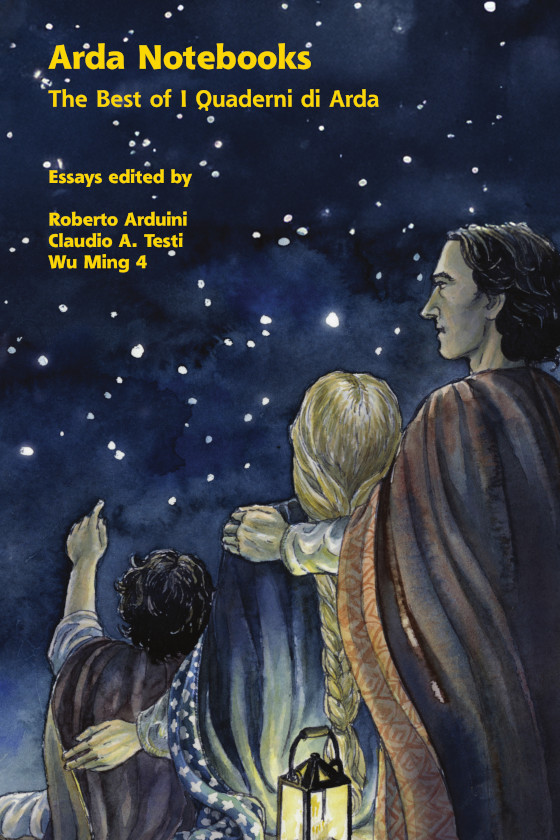
table of contents | abstracts | cover | announcements | more
Announcements
JTR reviews Arda Notebooks (19th August 2026)
Review of Arda Notebooks (28th June 2026)
New book - Arda Notebooks, The Best of I Quaderni di Arda (26th February 2026)
168 pages, Walking Tree Publishers 2025, Cormarë Series No. 55, Editors: Roberto Arduini, Claudio A. Testi & Wu Ming 4
, ISBN: 978-3-905703-55-9.
<--previous | all publications | next-->
how to buy this item

More on Arda Notebooks, The Best of I Quaderni di Arda
terms and conditions
visitors since
last updated