Environmentalism in Tolkien's Middle-earth
Rachel Falconer,Thomas Honegger, Christine Lötscher & Lukas Ritzel (editors)
Cormarë Series No. 58

<--previous | all publications | next-->
how to buy this item
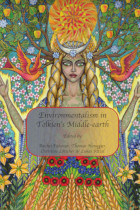
Environmentalism in Tolkien's Middle-earth brings together ten essays exploring Tolkien as a proto-environmentalist and deep ecologist before the term existed. From the tree-herding Ents of Fangorn to the maternal nature goddesses of The Silmarillion, from the ethical mining of Erebor to the corrupted wasteland of Mordor, the contributors reveal how Tolkien's legendarium presents a morally charged vision of humanity's relationship with the natural world. Drawing on ecocriticism, Jungian psychology, postcolonial theory, and deep ecology, the volume traces an evolution in Tolkien's ecological imagination across his entire body of work.
table of contents | abstracts | cover | announcements | more
Series Editors' Preface
Introduction
Rachel Falconer (Switzerland)
Habitatio est Omen: Landscape, Morality, and Identity in Tolkien's Legendarium
Thomas Honegger (Germany)
(abstract)
The Great Mothers of Biosphere: Yavanna, Melian, Galadriel
Alexandra (Oleksandra) Filonenko (Germany and Ukraine)
(abstract)
Tree by Tolkien
Patrick Curry (England)
(abstract)
Trees, Tales, and Tolkien: An Increasing Ecological Sensibility from The Hobbit to The Lord of the Rings
Andoni Cossio (Spain)
(abstract)
Tolkien's 'Luxuriant Animism': Unseen Beings and the Animacy of Arda
Erik Jampa Andersson (England)
(abstract)
Treebeard as an Eco-activist? An Ecocritical Perspective on the Ents
Hannah Sophie Schmitt (Switzerland)
(abstract)
Waking up the Trees: Reason, Emotion, and Recovery
in The Lord of the Rings
Martin Simonson (Spain)
(abstract)
"Our Trees and Our Lives Are in Great Danger":
Ecocriticism in J.R.R. Tolkien's The Hobbit or There and
Back Again and The Lord of the Rings
Max Bothe (Germany)
(abstract)
Mountains, Machines, and Morality – The Role of the Environment
in the Relative Morality of Technology in J.R.R. Tolkien's
The Lord of the Rings
Sarah Heinzelmann (Switzerland)
(abstract)
"If These Old Tales Speak True": Seeking Mythic Guidance
in Tolkien's Environmental Imaginings
Amber Lehning (USA)
(abstract)
table of contents | abstracts | cover | announcements | more
Abstracts
Habitatio est Omen: Landscape, Morality, and Identity in Tolkien's Legendarium
This article argues that landscape in J.R.R. Tolkien's legendarium functions as a moral, cultural, and narrative agent rather than a neutral backdrop. Building on the maxim habitatio est omen ("like land, like people"), it demonstrates how Tolkien consistently aligns ethical orientation, cultural identity, and historical memory with specific environments in Middle-earth. Drawing on a wide range of primary texts from The Silmarillion to The Lord of the Rings, and engaging with recent scholarship on spatiality, ecology, and cultural memory, the study shows that places in Tolkien's sub-created world both reflect and shape the moral character of their inhabitants. Landscapes bear memory, register corruption or harmony, and participate actively in the unfolding struggle between good and evil.
The Great Mothers of Biosphere: Yavanna, Melian, Galadriel
This paper examines the roles of Valië Yavanna, Melian the Maia, and Galadriel in the creation and preservation of Middle-earth's ecosystems in connection to vegetative and other natural imagery from the symbolic field of the Great Mother archetype. These three essential motherly figures embody the positive aspects of the Great Mother archetype, i.e. the Good Mother as described by the Jungian psychologist and philosopher Erich Neumann in his work The Great Mother: An Analysis of the Archetype. They are deeply interconnected, acting as creators – Yavanna of the entire Middle-earth biosphere – and protectresses of the natural realms of Middle-earth, albeit with diminishing power.
This paper examines the ecological dimensions of J.R.R. Tolkien's The Lord of the Rings, using trees as a central metonym for the more-than-human natural world. It argues that Tolkien's fiction is best approached through the lens of "applicability" rather than allegory, allowing readers to find ecological meaning without reducing the narrative to philosophical prescription. Three principal orientations toward nature are identified and discussed: anthropocentrism (both the ruthless, Sauronic kind and the technocratic, Sarumanic variety), stewardship (with its ambiguous relationship to human self-interest), and ecocentrism, which recognizes intrinsic value in all living beings independent of their utility to humans. A key thesis is that in Tolkien's world, nature and wonder (Faërie) form an inseparable double: the more-than-human world is the locus of enchantment, and enchantment in turn reveals the intrinsic value of the natural world. The Elves, bound to the Earth until its end, personify this union of nature and wonder most fully. The paper also argues that ecocentrism does not preclude all use of nature, but distinguishes between sustainable, sufficient use and destructive exploitation – a distinction embodied in the contrast between Hobbit culture and Sauron's Mordor. Finally, the paper considers the real-world effects of Tolkien's ecologism, noting documented influences on early environmental movements, while acknowledging that art's effects, though real, cannot be directed or controlled.
This chapter aims to trace the evolution of J.R.R. Tolkien's ecological perspective by analysing literary depictions of trees and forests from The Hobbit to The Lord of the Rings. After a brief review of biographical events that may have influenced the depiction of trees and wooded areas in these works, a theoretical ecocritical framework is presented for subsequent application to the analysis. The treed areas are then divided into three size-based groups (A [large], B [medium] and C [small]), while individual trees are categorised separately (group D). Each unit is assigned an alphanumeric code to facilitate the study of unnamed trees and tree groups, which is supplemented by a map of their distribution. After providing relevant explanations regarding context, methodology, technical specifications, and supplementary information, the study begins with the trees and forests in The Hobbit. It examines their narrative value, symbolism, and importance to the economy of Middle-earth. This enables a subsequent comparison and contrast with the trees and forests in The Lord of the Rings, which are also analysed in terms of their narrative value, symbolism, and economic significance. The study reveals that Tolkien's environmental vision is most clearly expressed in the transition from The Hobbit to The Lord of the Rings, and that this change is reflected more clearly in trees than in any other element in the two works.
Tolkien's 'Luxuriant Animism': Unseen Beings and the Animacy of Arda
This paper explores Tolkien's use of 'animism(s)' across the compositional layers of the Legendarium. I examine what 'animism' appears to have meant to Tolkien, how and where he encountered it, and how this informed his evolving mythopoeic strategies, tracing a shift from an early, more explicitly 'Tylorian' cosmology populated by named nature spirits to the more immanent and integral expressions of environmental agency found in The Lord of the Rings. The paper focuses on two key sites: the increasingly marginalised eco-daemonological spirits of the early Legendarium, and the Old Forest affair, where a decisive shift occurs in Tolkien's representation of animacy. As Old Man Willow transforms from an arboreal prison for an "earth-bound spirit" into an embodied person with a 'spirit' of his own, we see Tolkien move away from transcendent personification toward a more immanentist and relational model that closely approaches a neo-animist ontology. I then turn to Tom Bombadil, whose intrusion into the narrative at this juncture is of critical importance. I argue that Bombadil was modelled, at least in part, on the 'eternal bard' Väinämöinen of the Finnish Kalevala – a connection which has been noted in passing by previous scholars but never subjected to sustained analysis – and that this inheritance helps explain both the distinctive mythic atmosphere expressed in the Bombadil episode as well as his ostensibly 'shamanic' mode of engagement with the other-than-human world. As Tolkien's most explicit and mature "exemplar" of an animistic ethos, Bombadil functions as a conduit of ecocentric Recovery for both hobbits and the reader, guiding us across the threshold from the familiarity of The Shire into the perilous more-than-human world.
Treebeard as an Eco-activist? An Ecocritical Perspective on the Ents
Is Treebeard an eco-activist? In their march on Isengard, Treebeard and the other Ents take a deliberate stand against the devastation of Fangorn at the hands of Saruman and his Orcs. The Ents maintain a profound connection to nature: they are the tree-shepherds of Middle-earth, guardians of the forests, and beings created at Yavanna's request. Being a fusion of phytomorphic and anthropomorphic traits, they can be regarded as hybrid, or phytorealistic, beings. Their attachment to nature is thus both distinctive and inseparable from their hybrid condition.
This paper argues that Treebeard fulfils the defining characteristics of an eco-activist. These qualities are especially visible in the Ents' relationship with nature, which differs markedly from that of either the Entwives or Saruman. The Ents conceive of Fangorn as a Wildnis: at once uncontrolled and uncontrollable, yet simultaneously a site of primal and unmediated nature. Treebeard's conception of how Fangorn should be preserved thus makes him a forerunner of modern environmental movements. Notably, Treebeard's philosophy reveals significant affinities with the principles of the Deep Ecology movement.
As a consequence of this understanding of Wildnis, the Ents march on Isengard to resist the destruction carried out by Saruman's forces. Treebeard, therefore, emerges not as a peace activist but as an eco-activist, whose primary commitment lies in the protection and preservation of nature, and most especially of Fangorn.
Waking up the Trees: Reason, Emotion, and Recovery in The Lord of the Rings
Tolkien's experiences in the Great War not only enhanced his disgust with an ultra-technological modernity and reinforced his apparently reactionary nostalgia for pre-industrial bliss; it also paved the way for an angry and eloquent literary revolt against the machines. In The Lord of the Rings, the trees awake and strike back against political oppression and industrial blight in the shape of vengeful Ents, who combine reason and emotion in spite of their radical separation from humankind. However, Tolkien's portrayal of trees and forests in this work is not one of misty-eyed nostalgia, nor is it escapist; just like Men and Elves, trees are capable of both good and evil. At the same time, the anthropocentric worldview is subverted, and the very notion of good and evil is complicated by the fact that Ents and trees have their own agenda, based on both reason and emotion, in which the needs of other species are peripheral at best. In this paper, I look at Tolkien's portrayal of this process in The Lord of the Rings: from dormancy to an awakening, which triggers a response that in turn achieves a recovery of a more balanced and non-anthropocentric relationship with the natural world.
In light of the growing relevance of ecocriticism in the context of twenty-first-century ecological crises, literary works of all genres have recently been analyzed from an ecocritical perspective. This chapter focuses specifically on the environmental aspects of Tolkien's primary works set in Middle-earth during the Third Age, such as The Hobbit and The Lord of the Rings. Due to the spatial limitations of this chapter, the representation of forests and trees will be the main focus. The theoretical section of the chapter aims to enhance the reader's understanding of ecocriticism and the role of trees, both within and beyond the primary world. The analysis section applies literary ecocriticism to discuss the manifold functions and essential humanizing characteristics of the Ents and Huorns in Tolkien's works. Furthermore, it provides examples of spaces in which human and non-human beings coexist: Lothlórien and Mirkwood. The chapter argues that these texts promote peaceful and balanced coexistence as the most environmentally friendly form of culture within nature, and warns against the despoiling nature by Sauron's and Saruman's forces. The chapter concludes by affirming the hypothesis that Tolkien's works can be read through an ecocritical lens advocating the protection of nature in order to counteract the impact of technological developments.
This paper investigates the relative morality of technology in J.R.R. Tolkien's The Lord of the Rings. Focusing on the Dwarves and the forces of the Enemy, it argues that the morality of a given creationary activity primarily depends on its treatment of the environment, instead of, for instance, the character of its creations. Although Dwarves have a fundamentally harmonious relationship with Nature, this reading is notably illustrated by a comparison between Dwarf activity in Moria and Erebor: both manufactures strongly resemble each other in terms of their production size and use of materials, yet they strikingly differ with regard to their moral status. Given that only the Dwarves' attitude towards the environment – exploitative in Moria and respectful in Erebor – constitutes a significant difference between both sites, this dimension appears to represent the crucial factor determining their relative morality. Similarly, it is the Enemy's intimate association with environmental decay that seems to constitute a central reason for his condemnation within the legendarium. While, unlike the Dwarves, he uses industries instead of exercising a craft, his technological endeavors are not rejected for their industrial character or their production of weaponry but rather for the destruction of Nature they cause. Indeed, several episodes, particularly in Isengard and the Shire, reveal that most characters condemn the Enemy's activities upon beholding the lands ruined by his industries and not, crucially, assessing the machinery itself. This Nature-dependent perception of technology also raises several questions of morality regarding our own heavily industrialized society.
"If These Old Tales Speak True": Seeking Mythic Guidance in Tolkien's Environmental Imaginings
Mythmaking is a participative activity. Stories might originate as information or entertainment, but the most interesting and useful tales eventually transition into something deeper, something able to help people navigate the many uncertainties of human experience. There is no doubt that Tolkien's Middle-earth legendarium has made this leap from story into myth. This discussion will briefly examine the ins and outs of this mythmaking process, highlight some historical examples where Tolkien's fully-realized Secondary World explicitly influenced behavior in the environmental realm, and raise some ideas about how to translate the current excellent ecocritical scholarship on Middle-earth into positive mythic guidance for those struggling to navigate the environmental crises plaguing our Primary World today.
table of contents | abstracts | cover | announcements | more
Cover
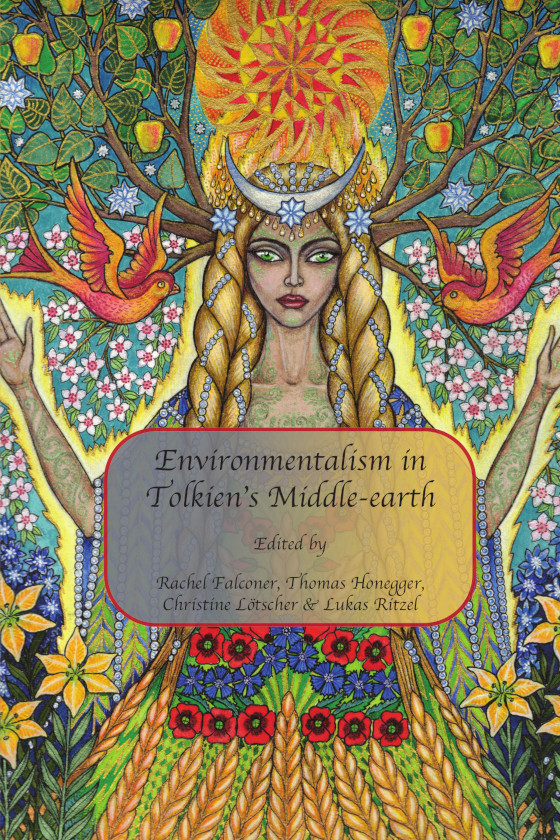
Cover illustration,
(Click above image to enlarge)
Artwork by Alexandra (Oleksandra) Filonenko
Cover design by Stefan Honegger
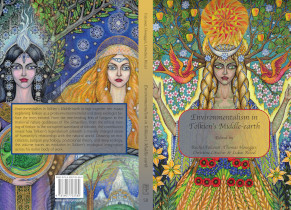
table of contents | abstracts | cover | announcements | more
Announcements
Environmentalism in Tolkien's Middle-earth published (20th August 2026)
259 pages, Walking Tree Publishers 2026, Cormarë Series No. 58, Editors: Rachel Falconer,Thomas Honegger, Christine Lötscher & Lukas Ritzel
, ISBN: 978-3-905703-58-0.
<--previous | all publications | next-->
how to buy this item

More on Environmentalism in Tolkien's Middle-earth
terms and conditions
visitors since
last updated